Animales en la vida cotidiana de la antigua Roma. Tres ejemplos: familia, dieta y piscifactorías
DOI:
https://doi.org/10.36151/DALPS.084Palabras clave:
Derecho Romano, animales de compañía, gastronomía romana, piscicultura, Derecho AnimalResumen
Este estudio examina la compleja relación entre humanos y animales en la vida cotidiana de la Roma antigua. a través de tres perspectivas paradigmáticas: los animales en el ámbito familiar, los animales como fuente alimentaria, y el desarrollo de la piscicultura romana. A partir del análisis de fuentes literarias, epigráficas y arqueológicas, se muestra que los romanos establecieron vínculos emocionales significativos con los animales con los que convivían en la casa, desarrollaron una gastronomía sofisticada basada en productos de origen animal, y crearon sistemas de acuicultura innovadores que sentaron precedentes para la piscicultura moderna. Esta investigación pone de relieve, que la consideración jurídica de los animales como res en el Derecho Romano, tan mal comprendida en los sistemas jurídicos contemporáneos, no obstaculizó el desarrollo de relaciones afectivas complejas con algunos animales, que encuentran paralelismos sorprendentes con la sensibilidad contemporánea hacia los animales de compañía. El estudio contribuye a un mejor conocimiento sectorial de la relación humano-animal en Roma, así como al debate actual sobre el estatuto jurídico de los animales, mostrando cómo las bases del Derecho Animal contemporáneo hunden sus raíces en la tradición socio-jurídica romana.
Descargas
Citas
AGOSTA, L. Empathy and sympathy in ethics. Internet Encyclopedia of Philosophy (2011). https://iep.utm.edu/emp-symp/
AGULHON, M. Le sang des bêtes. Le problème de la protection des animaux en France au XIXe siècle, in Romantisme 31 (1981) 81-109
AMAT, J. Les animaux familiers dans la Rome Antique (Paris 2022)
AMIOT, C. E., BASTIAN, B. Toward a psychology of human–animal relations, in Psychological bulletin 141/1 (2015) 6
ANKUM, J.A. La responsabilité des transporteurs maritimes en droit romain, in Tijdschrift voor Rechtsgeschiedenis 51 (1983) 257-289
ASH, H.B. Columella: On Agriculture, Volume II (Loeb Classical Library 407) (Harvard 1941) 473
ASH, H.B., FORSTER, E.S., HEFFNER, E.H. Columella: On Agriculture (Loeb Classical Library) (Harvard 1941-1955)
ASHTON-CROSS, D. I. C. Liability in Roman law for damage caused by animals, in The Cambridge Law Journal 11/3 (1953) 395-403. https://doi.org/10.1017/S000819730000595X
BALTRUSCH, E. Regimen morum: Die Reglementierung des Privatlebens der Senatoren und Ritter in der römischen Republik und frühen Kaiserzeit (Munich 1989) 45-78
BANNON, C. J. Fresh Water in Roman Law: Rights and Policy, in The Journal of Roman Studies 107 (2017) 60–89. https://doi.org/10.1017/S007543581700079X
BANNON, C. J. A Short Introduction to Roman Water Law, in Memoirs of the American Academy in Rome 66 (2021) 1–18. https://doi.org/10.2307/27129164
BARDOT-CAMBOT, A. Le commerce des coquillages marins en Gaule romaine: animaux « en coquille » et chair décoquillée, in BOTTE, E., LEITCH, V. (eds.). Fish & Ships: Production et commerce des salsamenta durant l'Antiquité. Arles/Aix-en-Provence (Bibliothèque d'Archéologie Méditerranéenne et Africaine 17, 2014) 75-87
BEARD, M. The Roman Triumph (Harvard 2007) 234-267
BEKKER-NIELSEN, T. Ancient Fishing and Fish Processing in the Black Sea Region (Black Sea Studies 2) (Aarhus 2005) 123-145
BEKKER-NIELSEN, T., GERTWAGEN, R. (eds.). The Inland Seas: Towards an Ecohistory of the Mediterranean and the Black Sea (Stuttgart 2023) 189-234
BENEFIEL, R. Dialogues of Graffiti in the House of the Four Styles at Pompeii, in BAIRD, J.A., TAYLOR, C. (eds.). Ancient Graffiti in Context (Abingdon-New York 2011) 20-48
BENTHAM, J. An Introduction to the Principles of Morals and Legislation (London 1789)
BERNAL-CASASOLA, D. (ed.). Arqueología de la pesca en el Estrecho de Gibraltar (Cádiz 2010)
BERNAL-CASASOLA, D., SÁEZ, A. Fish Processing and Salted-Fish Trade in the Punic West: New Archaeological Data and Historical Evolution, in BOTTE, E., LEITCH, V. (eds.). Fish & Ships. Production and Commerce of Salted Fish Products during Antiquity (École française de Rome 2014) 159-174
BODSON, L. Attitudes Toward Animals in Greco-Roman Antiquity, in International Journal for the Study of Animal Problems 4/4 (1983) 312-320
BODSON, L. Motivations for pet-keeping in Ancient Greece and Rome: a preliminary survey, in PODBERSCEK, A.L., PAUL, E.S., SERPELL, J.A. (Eds.). Companion Animals and Us: Exploring the Relationships between People and Pets (Cambridge 2000) 27-41
BOND, S. E. Getting sacked: Animals, executions, and Roman law. Sarah E. Bond Blog (2015). https://sarahemilybond.com/2015/10/04/getting-sacked-animals-bestial-humiliation-and-roman-law/
BOTTE, E. Salaisons et sauces de poissons en Italie du Sud et en Sicile durant l'Antiquité (Naples 2009)
BOTTE, E., JUNG, C., DETCHEVERRY, S. Le piscine del Pausilypon: Indagini archeologiche e approccio geomorfologico, in Méditerranée 116 (2011) 81-93
BOYD, B. W. The death of Corinna's parrot reconsidered: Poetry and Ovid's Amores, in The Classical Journal 82/3 (1987) 199-207. http://www.jstor.org/stable/3297900
BRADLEY, K. The Sentimental Education of the Roman Child: The Role of Pet-Keeping, in Latomus 57/3 (1998) 523–557. http://www.jstor.org/stable/41538365
BRADLEY, K. R. Animalizing the Slave: The Truth of Fiction, in Journal of Roman Studies 90 (2000) 110-125
BRADLEY, K. Animalizing the Slave: The Truth of Fiction, in BRADLEY, K. Apuleius and Antonine Rome: Historical Essays (Toronto - London 2012) 59-78
BRAUND, S.M. Juvenal: Satires Book I (Cambridge 1996) 234-245
BRAUND, S. Seneca: De Clementia (Oxford 2009) 128-131
BRAUND, S.M. Juvenal and Persius (Loeb Classical Library 91) (Harvard 2004) 447
BROGIOLO, G.P. Vivaria romani: archeologia e storia (Milano 2012)
BROTHWELL, D., BROTHWELL, P. Food in Antiquity: A Survey of the Diet of Early Peoples, expanded ed. (Baltimore 2020)
BUCKLAND, W.W. The Roman Law of Slavery (Cambridge 1908)
CAHOON, L. The parrot and the poet: The function of Ovid's funeral elegies, in The Classical Journal 80/1 (1984) 27-35. http://www.jstor.org/stable/3297395
CAMODECA, G. L'élite municipale di Puteoli, in CÉBEILLAC-GERVASONI, M. (Ed.). Les élites municipales de l'Italie péninsulaire de la mort de César à la mort de Domitien (Collection de l'École française de Rome 271) (Rome 2000) 91-110
CAMPBELL, G. L. Pliny's natural philosophy: Animals, humans, and moral exemplarity, in Classical Philology 113/4 (2018) 445-467
CASTIGLIONE, S., LOMBARDI VALLAURI, L. Trattato di biodiritto. La questione animale (Milano 2012)
CHANIOTIS, A. Moving stones: The study of emotions in Greek inscriptions, in A. Chaniotis (Ed.), Unveiling emotions: Sources and methods for the study of emotions in the Greek world (Stuttgart 2012)
CHANIOTIS, A. Listening to stones: Orality and emotions in ancient inscriptions, in J. Davies & J. Wilkes (Eds.), Epigraphy and the historical sciences (Oxford 2012) 299-328
CHARLES, N. ’Animals Just Love You as You Are': Experiencing Kinship across the Species Barrier, in Sociology 48/4 (2014) 715-730
CHOI, L. J. Memories in Stone: Ancient Pet Epitaphs and Poetry Bridging the Past and Present [BA thesis with honours] University of Arizona (2023). http://hdl.handle.net/10150/668568
CHRYSTAL, P. The Roman Family Pet (Chicago 2017)
CHRYSTAL, P. How to be a Roman: A Day in the Life of a Roman Family (Chicago 2017)
CLARKE, J. R. Domestic iconography and animal symbolism in Roman villa decoration. Papers of the British School at Rome 88 (2020) 89-112
CLUTTON-BROCK, J. Animals in Roman Britain: Archaeological evidence for human-animal relationships, in Britannia 52 (2021) 201-225
COLEMAN, K. Fatal Charades: Roman Executions Staged as Mythological Enactments, in Journal of Roman Studies 80 (1990) 44-73
COOLEY, A.E., COOLEY, M.G.L. Pompeii and Herculaneum: A Sourcebook, 2nd ed. (Abingdon - New York 2014)
COURTNEY, E. Musa Lapidaria. A Selection of Latin Verse Inscriptions, in American Classical Studies 36 (Virginia 1995)
CRAIG, O.E., et al. Stable Isotope Analysis of Marine and Terrestrial Protein in Roman Coastal Populations, in Journal of Archaeological Science 88 (2017) 64-73
CRAWFORD, M.H. (ed.). Roman Statutes, Vol. 1 (Institute of Classical Studies 1996) 355-391
CUBERO, J.I., Rerum Rusticarum Libri III, translated and comented (Sevilla 2010)
CUGUSI, P. Aspetti letterari dei Carmina Latina Epigraphica (Bologna1996)
CURTIS, R.I. Garum and Salsamenta: Production and Commerce in Materia Medica (Leyde 1991)
D'ARMS, J. H. Romans on the Bay of Naples: A social and cultural study of the villas and their owners from 150 B.C. to A.D. 400 (Harvard 1970)
D'ARMS, J.H. The Roman convivium and the idea of equality, in MURRAY, O. (ed.). Sympotica: A Symposium on the Symposion (Oxford 1990) 308-320
D'ARMS, J.H. Performing Culture: Roman Spectacle and the Banquet, in BERGMANN, B., KONDOLEON, C. (eds.). The Art of Ancient Spectacle (New Haven - London 1999) 301-319
DE GROSSI MAZZORIN, J. L'uso dei cani nel mondo antico nei riti di fondazione, purificazione e passaggio, in F. D'Andria, J. De Grossi Mazzorin, G. Fiorentino (Eds.), Uomini, piante e animali nella dimensione del sacro (Edipuglia 2008) 71-81
DESSE-BERSET, N. Ichthyofaunal Remains from the Roman Empire, in BEKKER-NIELSEN, T., CASASOLA, D.B. (eds.). Ancient Nets and Fishing Gear (Aarhus 2010) 176-198
DEVORE, G. Moralizing Spaces: The Regulation of Vice in Roman Cities (Oxford 2023) 189-234
DIERAUER, U. Tier und Mensch in Denken der Antike. Studien zur Tierpsychologie, Anthropologie und Ethik (Amsterdam 1977)
DIETRICH, J. S. Dead parrots society, in American Journal of Philology 123/1 (2002) 95-110. https://doi.org/10.1353/ajp.2002.0004
DILLON, S., WELCH, K. (Eds.). Representations of War in Ancient Rome (Cambridge 2006)
DONADIO, N. La tutela del compratore tra actiones aediliciae e actio empti (Milano 2004) ISBN 88-14-10979-6
DONAHUE, J. Food and Drink in Antiquity: A Sourcebook (London - New York 2020)
DUNBABIN, K.M.D. The Roman Banquet: Images of Conviviality, 2nd ed. (Cambridge 2020)
DUNCAN-JONES, R. The Economy of the Roman Empire: Quantitative Studies, 2nd ed. (Cambridge 1982)
DU PLESSIS, P. Borkowski's Textbook on Roman Law, 6th ed. (Oxford 2020)
EDWARDS, C. The Politics of Immorality in Ancient Rome (Cambridge 1993)
ELISEEVA, L., ANDREEVA, E. ‘Do Not Laugh, I Beg of You, for This Is a Dog’s Grave’: The Human-Canine Bond in the Ancient Greek World, in Dogs, Past and Present (2023) 339
ELLIS, S.J.R. The Roman Retail Revolution: The Socio-Economic World of the Taberna (Oxford 2018)
EMMERSON, A.L.C. rev. Death, funerals and memory in literature and art - VALERIE M. HOPE and JANET HUSKINSON (edd.), Memory and mourning. Studies on Roman death (Oxbow Books, Oxford 2011), in Journal of Roman Archeoklogy 35 (20212) 719-721. https://doi.org/10.1017/S1047759400001653
ERDKAMP, P. The Grain Market in the Roman Empire: A Social, Political and Economic Study (Cambridge 2005)
ERDKAMP, P. The Food Supply of the Roman City (Cambridge 2021)
ERDKAMP, P., HOLLERAN, C. (eds.). The Routledge Handbook of Diet and Nutrition in the Roman World (Abingdon - New York 2023)
FAAS, P. Around the Roman Table: Food and Feasting in Ancient Rome (Chicago, reissue 2020)
FAIRCLOUGH, H.R., revised by GOOLD, G.P. Horace: Satires, Epistles and Ars Poetica (Loeb Classical Library 194) (Harvard 1926/1999) 127
FAVRE, D. Living Property: A New Status for Animals Within the Legal System, in Marquette Law Review 93/3 (2010) 1021-1071
FAVRE, D., GIMÉNEZ-CANDELA, T. (eds.). Animales y Derecho/Animals and the Law (Valencia 2015)
FERRIS, I. Cave canem: Animals and Roman society (United Kingdom 2018)
FITZGERALD, W. Martial: The World of the Epigram (Chicago - London 2007)
FLACH, D. Marcus Terentius Varro: Gespräche über die Landwirtschaft, Buch 3 (Darmstadt 2002)
FÖGEN, T. ὀρνίθων ὡραιότατος and rara avis. The Peacock in Greek and Latin Literature, in Wiener Studien 136 (2023) 63-98
FÖGEN, T., THOMAS, E. (eds.). Interactions between Animals and Humans in Graeco-Roman Antiquity (Berlin - Boston 2017) 234-256
FÖGEN, T. Animals in Graeco-Roman Antiquity and beyond: A select Bibliography, in FÖGEN, T., THOMAS, E. (Eds.) Interactions between Animals and Humans in Graeco-Roman Antiquity (Berlin-Boston 2017) 435-474
FÖGEN, T. Zum Sterben und Tod von Tieren in lateinischen Trauergedichten, in Antike und Abendland 64/1 (2018) 130-155. https://doi.org/10.1515/anab-2018-640109
FORNI, G. Gli animali domestici in Roma antica (2005)
FORSTER, E.S., HEFFNER, E.H. Columella: On Agriculture, Volume II (Loeb Classical Library 1954) 445-449
FRANCO, C., Dogs and humans in ancient Greece and Rome: towards a definition of extende appropriate interaction, in Dog’s Best Friend (2019) 33-58
FRANCO, C. Working animals and social stratification in imperial Rome, in Journal of Social Archaeology, 20/3 (2020) 334-357
FRANCIONE, G. L. Animals as Persons: Essays on the Abolition of Animal Exploitation (New York 2008)
FRASH, P., HESSLER, K., KUTIL, S., WAISMAN, S. Animal Law in a Nutshell, 3 ed. (St. Paul, MN 2021)
FRIER, B. W., MCGINN, T. A. J. A casebook on Roman family law, 2 ed. (Oxford 2019)
FRÖHLICH, T., Tabernae und Popinae, in Rivista di Studi Pompeiani 15 (2004) 87-94
FUNSTEN, G. A learned dog: Roman elegy and the epitaph for Margarita, in The Classical Journal, 119/3 (2024). 320–346. https://doi.org/10.1353/tcj.2024.a919681
GARCÍA, M. et al., Análisis isotópicos de enterramientos conjuntos humano-animal en la Península Ibérica, in Archaeofauna 28 (2019) 87-102
GARCIA LORCA, F., Obra completa II. Poesía, 2 (Akal 2008)
GARNSEY, P. Food and Society in Classical Antiquity (Cambridge 1999)
GARNSEY, P., SALLER, R. The Roman Empire: Economy, Society and Culture, 2nd ed. (Oakland, CA 2014)
GARULLI, V. Gli epitafi greci per animali. Fra tradizione epigrafica e letteraria, in Studi Di Archivistica, Bibliografia, Paleografia, 1 (2014) 27-64
GEORGE, M. The 'Dark Side' of the Garden: Mourning Animals in Roman Funerary Art, in A Cultural History of Animals in Antiquity (2008)
GEORGE, M. The Roman family and domestic animals: Affection, utility, and social meaning, in Ancient Society 48 (2018) 145-172
GEORGOUDI, S. Funeral epigrams for animals, in Archaeologia (1984)
GERICK N. Recht, Mensch und Tier. Historische, philosophische und ökonomische Aspekte des tierethtiches Problems (Baden-Baden 2005)
GIGLIO, F. Pandectism and the Gaian Classification of Things, University of Toronto Law Journal 62/1 (2012). https://doi.org/10.3138/utlj.62.1.1
GIMÉNEZ-CANDELA, M. La lex Irnitana: une nouvelle loi municipale de la Bétique, in Revue Internationale des Droits de l'Antiquité, 30 (1983) 125-140
GIMENEZ-CANDELA, M. Dignity, Sentience, Personality: the legal relationship between animals and humans, in Derecho Animal. Forum of Animal Law Studies 9/2 (2018) 5-16. https://doi.org/10.5565/rev/da.385
GIMÉNEZ-CANDELA, M. Transición animal en Espana (Valencia 2019)
GIMENEZ-CANDELA, M. Animal Law: What is Left to be said by the Law about Animals, in VITALE, A., POLLO, S. (Eds.). Human-Animals Relationships in Transformation. Scientific, Moral and Legal Perspectives (Cham 2022) 363-401
GIMÉNEZ-CANDELA, M. Biolegalità e nuove soggettività, in DI ROSA, G., LONGO, S., MAUCERI, T. (a cura di). Diritto e tecnologia. Precedenti storici e problematiche attuali. Atti delle giornate di studi (Catania, 8 ottobre 2021 - 21 e 22 ottobre 2022 25 novembre 2022 - 19 e 20 maggio 2023) (Napoli 2024) 217 ss.
GIMÉNEZ-CANDELA, M., CERSOSIMO, R. La enseñanza del Derecho Animal (Valencia 2021)
GIMÉNEZ-CANDELA, M., CERSOSIMO, R. Teaching Animal Law in Europe, in Animal and Natural Resource Law Review 20 (2024) 51-71
GIROLA, C. Imaginarios sobre perros y gatos en la Antigüedad, in Dialogues d'histoire ancienne 45/2 (2019) 45-67
GONZÁLEZ, J. The Lex Irnitana: A New Copy of the Flavian Municipal Law, in Journal of Roman Studies 76 (1986) 147-243
GONZÁLEZ MARINO, I. La familia multiespecie: avances y desafíos jurídicos en Latinoamérica, in TLA-MELAUA: revista de ciencias sociales 54 (2023) 1-13. http://dx.doi.org/10.32399/rtla.17.54.2698
GOWERS, E. The Loaded Table: Representations of Food in Roman Literature (Oxford 1993)
GOWERS, E. Lesbia's controversial bird: Testing the cases for and against passer as sparrow, in Antichthon 55 (2022) 1-24. https://doi.org/10.1017/ann.2021.8
GRAINGER, S. The story of garum. Fermented Fish Sauce and Salted Fish in the Ancient World (Abingdon - New York 2021)
GRANINO CECERE, M.G., Il sepolcro della catella Aeolis, in ZPE 100 (1994) 413-421. https://www.uni-koeln.de/phil-fak/ifa/zpe/downloads/1994/100pdf/100413.pdf
GRETTON, G. L. Ownership and its Objects, en Rabels Zeitschrift für ausländisches und internationales Privatrecht / The Rabel Journal of Comparative and International Private Law, 71/4 (October 2007) 802-851
GRIER, K. C., Pets in America: A History (University of North Carolina Press 2006)
GRIFFIN, M. Seneca on Society: A Guide to De Beneficiis (Oxford 2013)
GROCOCK, C., GRAINGER, S. Apicius: A Critical Edition with an Introduction and English Translation (Totnes 2006)
HANAGHAN, M., Pliny’s Seneca and the intertextuality of Grief (Chapter 7) 149-163, in NEGER, M., TZOUNAKAS, S. (Eds.) Intertextuality in Pliny’s Epistles (Cambridge 2023) 149-163
HARDEN, A. Exotic animals as status symbols in Roman elite culture. Greece & Rome 67/2 (2020) 178-195
HARLOW, M.V. rev. Memory and mourning: studies on Roman death by V. HOPE; J. HUSKINSON; Living through the dead: burial and commemoration in the classical world (Studies in Funerary Archaeology 5) by M. CARROLL; J. REMPEL, in Journal of Roman Studies (2012) 102:330-332
HERZOG, H., BLACKSHAW, J. K., LAWRENCE, E. A. Pets and Paradoxes: Review of In the Company of Animals (second edition (1997) James Serpell, in Anthrozoös, 10/4 (1977) 236–240. https://doi.org/10.2752/089279397787000978
HESELTINE, M., revised by ROUSE, W.H.D. Petronius, Seneca: Satyricon, Apocolocyntosis (Loeb Classical Library 15, Harvard 1913/1987) 71
HIGGINBOTHAM, J. Piscinae: Artificial Fishponds in Roman Italy (Chapel Hill 1997)
HIRT RAJ, M. Médecine vétérinaire et société dans les mondes grec et romain, in Pallas 84 (2010) 17-31
HOFFMAN, G.L. Parasites of North American Freshwater Fishes (Berkeley-Los Angeles 1967)
HOFFMANN, R.C. Frontier Foods for Late Medieval Consumers: Culture, Economy, Ecology, in Environment and History 7 (2001) 131-167
HOLLERAN, C. Shopping in Ancient Rome: The Retail Trade in the Late Republic and the Principate (Oxford 2022) 167-189
HOLLERAN, C. Food in the City, in HOLLERAN, C., ERDKAMP, P. (eds.). The Oxford Handbook of the Roman Economy (Oxford 2023) 589-612
HOLLERAN, C., ERDKAMP, P. (eds.). The Oxford Handbook of the Roman Economy (Oxford 2023) 567-594
HOLLERAN, C., PERRY, J.S. (eds.). The Oxford Handbook of Roman Commerce and Trade (Oxford 2023) 456-478
HOOPER, W.D., revised by ASH, H.B. Cato and Varro: On Agriculture (Loeb Classical Library 283) (Harvard Press 1934) 519
HOPE, V. M. Status and identity in the Roman world, in HUSKINSON, J. (Ed.) Experiencing Rome (London 2000) 28
HOPE, V. M., HUSKINSON, J. (Eds.). Memory and mourning: Studies on Roman death (Oxford - Oakville 2011)
HUGHES, B., LEWIS HARKIN, B. The impact of continuing bonds between pet owners and their pets following the death of their pet: A systematic narrative synthesis, in OMEGA. Journal of Death and Dying, 90/4 (2022) 1666–1684. https://doi.org/10.1177/00302228221125955
HUME, D. A. Treatise of Human Nature (1739-1740)
IHM, S., s.v. “Haustiere”, in Der Neue Pauly 12/2 (Stuttgart-Weimar 2002) 989–991
INGLEHEART, J. Catullus 2 and 3: A programmatic pair of Sapphic epigrams?, in Mnemosyne, 56/5 (2003) 551-565. https://doi.org/10.1163/156852503322904562
INGOLD, T. From Trust to Domination: An Alternative History of Human-Animal Relations, in MANNING, A., SERPELL, J. (Eds.). Animals and Human Society (London 1994) 1-22
IRVINE, L. If You Tame Me: Understanding Our Connection with Animals (Philadelphia 2004)
JACKSON, B. S. Liability for animals in Roman law: An historical sketch, en The Cambridge Law Journal, 37/1 (1978) 122-143. https://www.jstor.org/stable/i406640
JACKSON, C.E. Peacock, (London 2006)
JAKAB, É. Risikomanagement beim Weinkauf (Munich 2009)
JASHEMSKI, W.F., MEYER, F.G. (eds.). The Natural History of Pompeii (Cambridge 2002) 420-437
JONES, W.H.S. Pliny: Natural History, Volume VIII, Books 28-32 (Loeb Classical Library 418) (Harvard 1963) 453-455
JONGMAN, W.M. The Food Supply of Rome, in HOLLERAN, C., ERDKAMP, P. (eds.). The Oxford Handbook of the Roman Economy (Oxford 2023) 678-701
JONGMAN, W. The Early Roman Empire: Consumption, in SCHEIDEL, W., MORRIS, I., SALLER, R. (eds.). The Cambridge Economic History of the Greco-Roman World (Cambridge 2007) 592-618
JOSHEL, S.R., PETERSEN, L.H. The Material Life of Roman Slaves (Cambridge 2014)
JOSHEL, S.R. Work, Identity, and Legal Status at Rome (Norman 1992)
KAIBEL, G. Epigrammata Graeca ex lapidibus conlecta (Berlin, 1878; repr. Hildesheim, 1965)
KAISER, A. Mobility and Connectivity in Roman Pompeii, in POEHLER, E. (Ed.). The World of Pompeii (Abingdon-New York 2023) 345-367
KEHOE, D.P. Property rights over land and economic growth in the Roman Empire, in SCHEIDEL, W. (Ed.). The Cambridge companion to the Roman economy (Cambridge 2012) 89-112
KEHOE, D.P. Law and the rural economy in the Roman Empire (Ann Arbor 2007) 156-189
KEHOE, D.P., RATZAN, D.M., YOO, U. (Eds.). Law and transaction costs in the ancient economy (Ann Arbor 2015)
KLEBERG, T. Hôtels, restaurants et cabarets dans l'antiquité romaine (Uppsala 1957)
KING, A. Diet in the Roman World, in Journal of Roman Studies 89 (1999) 168-182
KNIGHT, J. (ed.). Animals in Person: Cultural Perspectives on Human-Animal Intimacies (London 2005)
KING, A., FRAYN, J. Animals and Economics in the Ancient World (Cambridge 2020) 89-112
KRON, G. The much maligned peasant: comparative perspectives on the productivity of the small farmer in classical antiquity, in HANS, L.M. (Ed.). La producción agrícola de excedente en los sistemas agrarios antiguos (Barcelona 2008) 71-119
KRON, G. The distribution of wealth at Athens in comparative perspective, in Zeitschrift für Papyrologie und Epigraphik 179 (2011) 129-138
KRON, G. The Distribution of Wealth in the Roman Empire, in HOLLERAN, C., ERDKAMP, P. (eds.). The Oxford Handbook of the Roman Economy (Oxford 2023) 567-594
KRONENBERG, L. J. Aemilius Macer as Corinna's parrot in Ovid Amores 2.6., in American Journal of Philology 137/2 (2016), 259-295. https://doi.org/10.1353/ajp.2016.0016
KRUSCHWITZ, P. Every Dog Has His Day (Academic blog entry) The Petrified Muse (2015, June 20). https://thepetrifiedmuse.blog/2015/06/20/every-dog-has-his-day/
KRUSCHWITZ, P. The Master and Margarita. (Academic blog entry) The Petrified Muse (2015). https://thepetrifiedmuse.blog/2015/04/14/the-master-and-margarita/
KRUSCHWITZ, P. Linguistic variation, language change, and Latin inscriptions, in C. Bruun, J. Edmondson (Eds.). The Oxford Handbook of Roman Epigraphy (Oxford 2015) 721-74. https://doi.org/10.1093/oxfordhb/9780195336467.013.033
KUPISCH, B. Römische Sachmängelhaftung: Ein Beispiel für die 'ökonomische Analyse des Rechts'?, in Tijdschrift voor Rechtsgeschiedenis 70 (2002) 21-54
KURKI, V. A. A Bird's‐Eye View of Animals in the Law, in The Modern Law Review, 87/6 (2024) 1452-1479. https://doi.org/10.1111/1468-2230.12886
KYLE, D.G. Spectacles of Death in Ancient Rome (London 1998) 156-189
LAES, C. Silent Witnesses? Children and Crises in the Roman World, in Children and Family in Late Antiquity (Leuven 2014) 85-110
LAES, C. Children and animals in the Roman world: Socialization, care, and emotional bonds. Journal of Family History 46/1 (2021) 23-41
LAFON, X. Villa Maritima: Recherches sur les villas littorales de l'Italie romaine (Bibliothèque des Écoles françaises d'Athènes et de Rome 307) (Rome 2001) 345-389
LAGÓSTENA BARRIOS, L. La cetaria de Baelo Claudia, in LAGÓSTENA, L., BERNAL, D., ARÉVALO, A. (eds.). Cetariae 2005: Salsas y salazones de pescado en Occidente durante la Antigüedad (Cádiz 2007) 309-331
LAMB, J. The Evolution of Sympathy in the Long Eighteenth Century (London 2009)
LANCASTER, L.C. Innovative Vaulting in the Architecture of the Roman Empire (Cambridge 2015)
LATTIMORE, R. Themes in Greek and Roman Epitaphs (Urbana 1962)
LAVAN, M. rev. Roman death. (V.M.) Hope, (J.) Huskinson (edd.) Memory and Mourning. Studies on Roman Death, in The Classical Review 64/1 (2014) 231-232. https://doi.org/10.1017/S0009840X13003144
LAVORGNA, B. F., HUTTON, V. E. Grief severity: A comparison between human and companion animal death, in Death Studies 43/8 (2019) 521–526. https://doi.org/10.1080/07481187.2018.1491485
LAZENBY, F. Greek and Roman Household Pets, in The Classical Journal 44/4 (January 1949) 245-252 y 44/5 (February 1949) 2909-307
LEE, S. A. Does the DSM-5 grief disorder apply to owners of deceased pets? A psychometric study of impairment during pet loss, in Psychiatry Research 285 (2020) 112800. https://doi.org/10.1016/j.psychres.2020.112800
LEONHARDT-PARR, E., RUMBLE, B. Coping with animal companion loss: A thematic analysis of pet bereavement counselling, in OMEGA - Journal of Death and Dying, 89/1 (2024) 362–378. https://doi.org/10.1177/00302228211073217
LEPETZ, S. L'animal et l'alimentation à l'époque romaine, in Gallia 58 (2001) 29-43
LEWIS, S., LLEWELLYN-JONES, L. The Culture of Animals in Antiquity: A Sourcebook with Commentaries (London 2018), Chapter 5, “Pets”. https://doi.org/10.4324/9781315201603
LEWIS, S. Pets as humans and humans as pets in imperial Rome, in Arethusa 58/2 (2025) 143-164. https://doi.org/10.1353/are.2025.a962487
LIGIOS, M.A. CIL VI, 9801 = ILS 7500: Aurelia Nais, imprenditrice del settore ittico?, in Tesserae Iuris Romani. Scritti per Salvatore Puliatti, vol. 1, Edizioni Scientifiche Italiane (2023) 213-233
LINTOTT, A. The Constitution of the Roman Republic (Oxford 1999)
MACAULAY-LEWIS, E. The City in Motion: Walking for Transport and Leisure in the City of Rome, in MCGINN, T.A.J. (ed.). Obligations in Roman Law (Ann Arbor 2012)
MACKAIL, J. W. Select Epigrams from the Greek Anthology (1890), epitaph LIV
MACKINNON, M. Zooarchaeological evidence for human-animal relationships in Roman urban contexts, in Oxford Journal of Archaeology 38/4 (2019) 412-435
MACKINNON, M. Pets, in G. Lindsay Campbell (Ed.), The Oxford Handbook of Animals in Classical Thought and Life (Oxford 2014) 269–281
MACKINNON, M. Osteological Research in Classical Archaeology (Abingdon-New York 2021) 145-178
MCLEOD, G. Wild and tame animals and birds in Roman law, in BIRKS. P. (Ed.), New perspectives in the Roman law of property: Essays for Barry Nicholas (Oxford 1989) 169-189
MARGUÉNAUD, J.P., LEROY, J. (eds.). Code de l’animal, 3 ed. (Paris 2024)
MARTÍNEZ, M. I., BAHAMONDE, A., TRONCOSO, I., CONCHA-SALGADO, A. Euthanasia and prolonged grief: A cross-sectional study with bereaved pet owners, in Journal of Veterinary Behavior 75 (2025) Article 104007. https://doi.org/10.1016/j.jveb.2025.04.007
MARZANO, A. Roman Villas in Central Italy: A Social and Economic History (Leiden 2007)
MARZANO, A. Harvesting the Sea: The Exploitation of Marine Resources in the Roman Mediterranean (Oxford 2013)
MARZANO, A. Roman Villas and Fish Ponds: A Question of Profit or Prestige?, in Journal of Roman Archaeology 28 (2015) 238-265
MARZANO, A. Fish and Fishing in the Roman World, in Journal of Maritime Archaeology 13 (2018) 437-447
MARZANO, A. Capital Investment and Elite Prestige in Roman Aquaculture, in HOLLERAN, C., ERDKAMP, P. (eds.). The Oxford Handbook of the Roman Economy (Oxford 2023)
MASSARO, M. L'impaginazione delle iscrizioni latine metriche e affettive, in Atti della Pontificia Accademia Romana di Archeologia 85 (2012). 365-414
MASSARO, M. Fra poesia e prosa affettiva in iscrizioni sepolcrali (a proposito di nuove raccolte territoriali iberiche di CLE), in Epigraphica 74 (2012) 279-308
MÉNISSIER, G. L'animal et le droit (Paris 2019) 45-78
MICHEL, M., KUHNE, D., HANNI, J. Animal Law – Tier und Recht, Development and Perspectives in the 21st Century – Entwicklungen und Perspektiven im 21. Jahrhundert, (Zürich - San Gallen 2012)
MONTEIX, N. Les lieux de métier: Boutiques et ateliers d'Herculanum (Bibliothèque des Écoles françaises d'Athènes et de Rome 344) (Rome 2010) 234-278
MORENO SOLDEVILA, R., MARINA CASTILLO, A., FERNÁNDEZ VALVERDE, J. A prosopography to Martial's epigrams (Berlin-Boston 2019). https://doi.org/10.1515/9783110614695
MOURITSEN, H. The Freedman in the Roman World (Cambridge 2011)
MOUSOURAKIS, G. Fundamentals of Roman Private Law (Berlin - Heidelberg 2012) 234-267
MULLIN, M.H. Mirrors and Windows: Sociocultural Studies of Human-Animal Relationships, in Annual Review of Anthropology 28 (1999) 201-224
MURPHY, C., et al. Alimentary Evidence from Pompeii: Animal Remains in Commercial Food Establishments, in Journal of Roman Archaeology 35 (2022) 234-261
MYERS, K. S. Ovid's tecta ars: Amores 2.6, "programmatics and the parrot". In Échos du Monde Classique/Classical Views 34 (1990) (n.s.9) 367-374. https://doi.org/10.1353/ecm.1990.0014
NAGY, G. Two small comments on Catullus Two: An iconic effect and an expression of delight in what is beautiful, in Classical Inquiries (2018, December 13). https://classical-inquiries.chs.harvard.edu/two-small-comments-on-catullus/
NEWMYER, S.T. Animals in Greek and Roman Thought: A Sourcebook (Abingdon - New York 2011) 89-134
NUSSBAUM, M. C. The Capabilities Approach and Animal Entitlements, in SUNSTEIN, C.R., NUSSBAUM, M.C. (Eds.). Animal Rights. Current Debates and New Directions (New York 2004) 28-254
OSYPIŃSKA, M., OSYPIŃSKI, P., DZIERZBICKA, D., & ZYCH, I. Animal cemetery of the early Roman period in Berenike: Undistinguishable taphonomy and the human-animal relationship, in World Archaeology, 53/5 (2021) 831-849. https://doi.org/10.1080/00438243.2022.2153039
PAPPALARDO, U., CIARDIELLO, R. Oplontis (Roma 2019)
PERRIN, B. Plutarch's Lives, Volume II (Loeb Classical Library 47) (Harvard 1914) 579
PERSI, V. L’acquisizione del dominio tramite occupazione. Il rapporto testo-immagine nelle illustrazioni del libro 41, tit. 1 del Digesto e del libro 2, tit. 1 delle Istituzioni di Giustiniano nei manoscritti della BnF (XIII-XIV secolo), in Clio@Themis 21 (2021). https://doi.org/10.35562/cliothemis.1866
PETERS, J. Römische Tierhaltung und Tierzucht (Rahden 1998)
PETERS, A. (ed.). Studies in Global Animal Law (Berlin 2020)
PIHKALA, P., AALTOLA, E. Animal ethical mourning: Types of loss and grief in relation to non-human animals, in Frontiers in Veterinary Science, 12 (2025). Article 1526302. https://doi.org/10.3389/fvets.2025.1526302
PREVIDE, E.P., RICCI, E.B., COLOMBO, E. S., et al. The Complexity of the Human–Animal Bond: Empathy, Attachment and Anthropomorphism in Human–Animal Relationships and Animal Hoarding, in Animals 12/20 (2022) 2835. https://doi.org/10.3390/ani12202835
PRILLOFF, R.J. rev. PETERS, J. Römische Tierhaltung und Tierzucht (Raden-Westf. 1998), in Würzburger Jahrbücher für die Altertumswissenschaft 41 (2017) 654-657
PROWSE, T., et al. Isotopic and Dental Evidence for Dietary Variability at Pompeii and Herculaneum, in American Journal of Physical Anthropology 175/4 (2021) 872-895
PURCELL, N. Eating Fish: The Paradoxes of Seafood, in WILKINS, J., HARVEY, D., DOBSON, M. (Eds.). Food in Antiquity (Exeter 1995) 132-149
PURPURA, G. Ricerche in tema di ius piscandi, in Annali del Seminario Giuridico dell'Università di Palermo 38 (1985) 239-338
RACKHAM, H. Pliny: Natural History, Volume III, Books 8-11 (Loeb Classical Library 353) (Harvard 1940) 511-513
RAWSON, E. Discrimina Ordinum: The Lex Iulia Theatralis, in Papers of the British School at Rome 55 (1987) 83-114
REAY, B. Agriculture, Writing, and Cato's Aristocratic Self-Fashioning, in Classical Antiquity 24 (2005) 331-361
REYES ORTIZ, A. Reconocimiento a las familias multiespecies en México. Análisis a la sentencia de amparo directo 454/2021 del tribunal colegiado en materia administrativa. DALPS (Derecho Animal-Animal Legal and Policy Studies) 2 (2024) 460-477. https://doi.org/10.36151/DALPS.031
RITVO, H. The Animal Estate: The English and Other Creatures in the Victorian Age (1987)
ROBINSON, O.F. The Criminal Law of Ancient Rome (Baltimore 2020)
ROBINSON, O.F. Ancient Rome: City Planning and Administration (Abingdon-New York 1992)
ROGERS, A.J. Aquaculture in the Ancient World: Ecosystem Engineering, Domesticated Landscapes, and the First Blue Revolution, in J Archaeol Res 32 (2024) 427–491. https://doi.org/10.1007/s10814-023-09191-1
ROLFE, J.C. The Attic Nights of Aulus Gellius, Vol. 1 (Loeb Classical Library 195) (Harvard 1927)
ROLFE, J.C. Suetonius: Lives of the Caesars, Volume I (Loeb Classical Library 31) (Harvard 1914)
ROUSSEAU, J. J. Discours sur l'origine et les fondements de l'inégalité parmi les hommes. (Amsterdam 1755)
ROUSSEAU, J. J. Émile, ou de l'éducation (The Hague 1762)
RYAN, F.X. Distributions of Meat in Rome, Athenaeum 108 (2020) 456-478
SÁEZ ROMERO, A. M. Fish Processing and Salted-Fish Trade in the Punic West: New Archaeological Data and Historical Evolution, in E. BOTTE, V. LEITCH (eds.), Actes de l'atelier doctoral, Rome 18-22 juin 2012. Arles: Éditions Errance; Aix-en-Provence: Centre Camille Jullian. (Bibliothèque d'Archéologie Méditerranéenne et Africaine, 17) 159-174
SALESSE, K., et al. Subsistence Strategies in Roman Coastal Communities: Isotopic Evidence from Italy and Hispania, in American Journal of Physical Anthropology 173/2 (2020) 234-256
SCHAFFNER, J.E. An Introduction to Animals and the Law (Palgrave Macmillan 2011)
SCHEIDEL, W. Real Slave Prices and the Relative Cost of Slave Labor in the Greco-Roman World, in Ancient Society 35 (2005) 1-17
SCHEIDEL, W. (ed.). The Cambridge Companion to the Roman Economy (Cambridge 2012) 114-131
SCHEIDEL, W., FRIESEN, S.J. The Size of the Economy and the Distribution of Income in the Roman Empire, in Journal of Roman Studies 99 (2009) 61-91
SCHMÖLDER-VEIT, A. Fish Ponds in Ancient Italy: Preliminary Results of a Research Project, in Mitteilungen des Deutschen Archäologischen Instituts, Römische Abteilung 116 (2009) 97-114
SHACKLETON BAILEY, D.R. Martial: Epigrams, Volume III (Loeb Classical Library 480) (Harvard 1993) 89
SHELTON, K.J. The Esquiline Treasure (London 1981)
SERPELL, J. In the company of animals: A study of human-animal relationships (Cambridge University Press 1996)
SERPELL, J., PAUL, E. Pets and the development of positive attitudes to animals, in Animals and human society (Abington-New York 2002) 165-182
SIRKS, A.J.B. Food for Rome: The Legal Structure of the Transportation and Processing of Supplies for the Imperial Distributions in Rome and Constantinople (Gieben 1991)
SIRKS, A.J.B. Sailing in the Off-Season with Reduced Financial Risk, in CAIRNS, J.W., DU PLESSIS, P.J. (Eds.). Beyond Dogmatics: Law and Society in the Roman World (Edinburgh 2007) 134-150
SLATER, W. Dining in a Classical Context (Ann Arbor 1991)
SMITH, A., The Theory of Moral Sentiments (London1759)
SPENCER, J. Writing About Animals in the Age of Revolution (Oxford 2020)
STEVANATO, C. La morte dell’animale d’affezione nel mondo romano tra convenzione, ritualità e sentimento: un’indagine «zooepigrafica», in I Quaderni del Ramo d’Oro en-line 8 (2016) 34-65
TEMIN, P. The Roman Market Economy (Princeton 2013) 89-112
THOMAS, J.A.C. Reflections on Animal Life in Roman Law, in Revue Internationale des Droits de l'Antiquité 17 (1970) 291-309
THOMAS, K. Man and the Natural World: Changing Attitudes in England 1500-1800 (1983)
THURMOND, D. L. Commemorating companion animals: Epitaphs and emotional relationships in Roman society, in Classical World, 114/3 (2021) 289-314
TONIOLO, A. Il garum: produzione e commercio, in QUILICI, L., QUILICI GIGLI, S. (eds.). Il mare e le risorse marittime (Rome 2002) 103-122
TOYNBEE, J. M. C. Animals in Roman Life and Art (Baltimore - London 1973)
TRAN, N. Associations, Commercial Activities, and Roman Law, in HOLLERAN, C., ERDKAMP, P. (eds.). The Oxford Handbook of the Roman Economy (Oxford 2023) 398-419
TRAN, N. Les membres des associations romaines: Le rang social des collegiati en Italie et en Gaules sous le Haut-Empire (Rome 2006) 234-237
TRIMBLE, G. Catullus: Poem 64. Cambridge Classical Texts and Commentaries, 64 (Cambridge 2025). https://doi.org/10.1017/9781139088213
TUCK, S.L. A History of Roman Art, in ÖSTENBERG, I., et al. (eds.). The Moving City: Processions, Passages and Promenades in Ancient Rome (Bloomsbury 2021) 234-256
VELAZA, J., Mantua me genuit. Génesis, datación y modelos epigráficos del “autoepitafio” de Virgilio, in Anuari de Filologia. Antiqua et Mediaevalia 8 (2018) 875-891
VERBOVEN, K. The Freedman Economy of Roman Italy, in BELL, S., RAMSBY, T. (Eds.), Free at Last!: The Impact of Freed Slaves on the Roman Empire (London 2012) 89-109
VOLTAIRE, Dictionnaire philosophique (Genève 1764)
VEYNE, P. Bread and Circuses: Historical Sociology and Political Pluralism (Penguin 1990) 232-287
WALLACE-HADRILL, A. The Social Structure of the Roman House, in Papers of the British School at Rome 56 (1988) 43-97
WATSON, A. Rome of the XII Tables: Persons and property (Princeton 1975)
WATSON, A. (Ed.). The Digest of Justinian, Vol. 1 (Princeton1985)
WIBIER, M. Water Rights and Property Regimes in Roman Law, in Journal of Roman Studies 110 (2020) 134-167
WILLIAMS, C. A. Epigraphic expressions of grief: Human-animal relationships in Roman funerary culture, in Phoenix 74/1-2 (2020) 87-108
WILSON, A. Marine Resource Exploitation in the Cities of Coastal Tripolitania, in MARZANO, A., BRIZZI, G. (Eds.). Cells and Sails: Economic Opportunity and Sea-borne Trade in Ancient Sicily and the Central Mediterranean (Oxford 2020) 156-178
WISE, S. M. Rattling the Cage. Towards Legal Rights for Animals (Cambridge, MA 2000)
WOODRING, C. E. Memories in stone: Ancient pet epitaphs and poetry bridging the past and present (Master's thesis, University of Arizona). University of Arizona Repository (2023). https://repository.arizona.edu/handle/10150/668568
WU, Y., SONG, J. The relationship between pet attachment and pet loss grief in Chinese undergraduates: A conditional process model, in Behavioral Sciences 15/4 (2025). Article 431. https://doi.org/10.3390/bs15040431
ZANDA, E. Fighting Hydra-Like Luxury: Sumptuary Regulation in the Roman Republic (London - New York 2021) 112-134
ZARMAKOUPI, M. (ed.). The Villa of the Papyri at Herculaneum: Archaeology, Reception, and Digital Reconstruction (Berlin - New York 2010)
ZEVI, F., et al. Le ville romane di Baia, in Mélanges de l'École française de Rome - Antiquité 132 (2020) 234-278
ZIMMERMANN, R. The Law of Obligations: Roman Foundations of the Civilian Tradition (Oxford 1996)
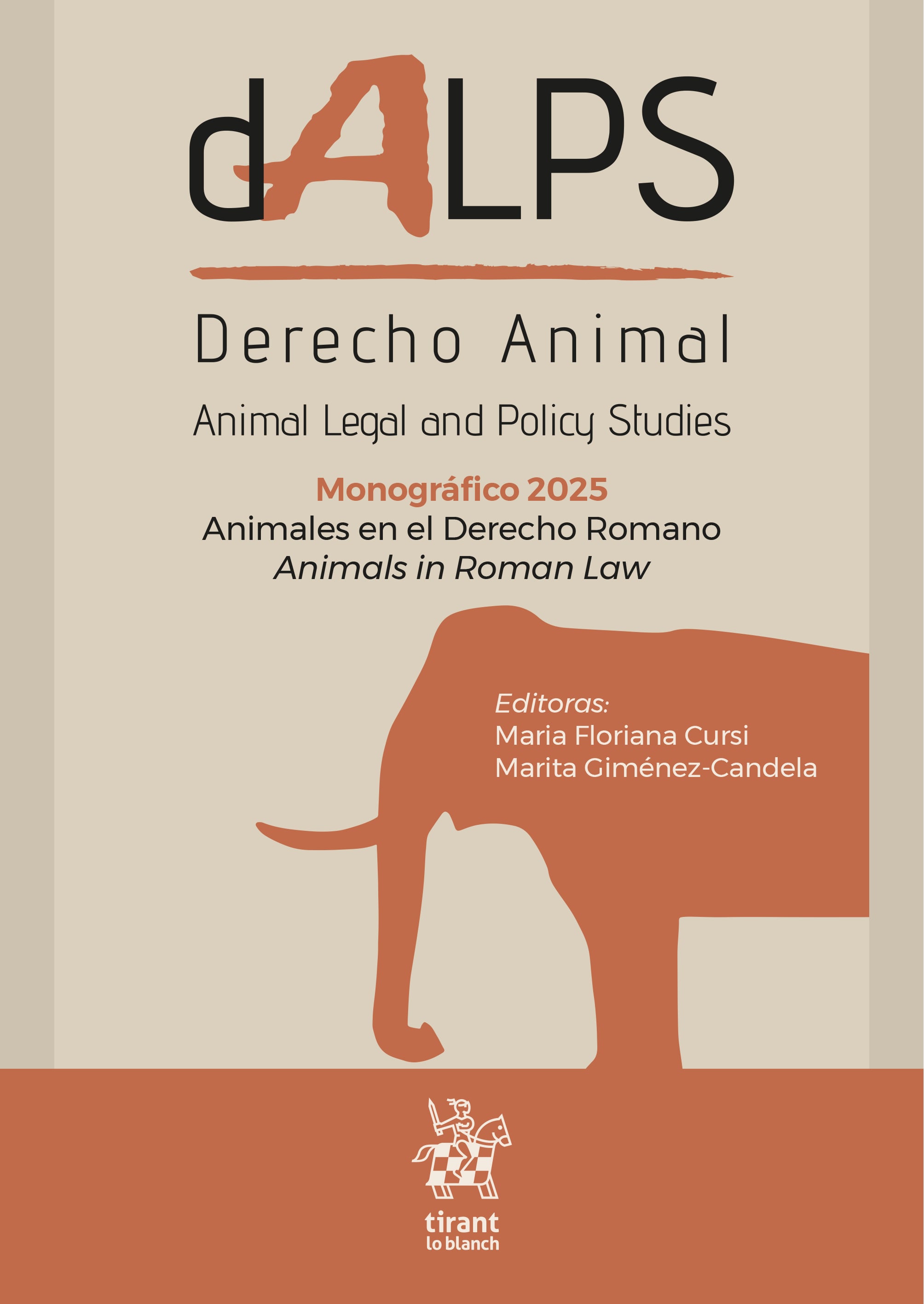
Descargas
Publicado
Cómo citar
Número
Sección
Licencia
Derechos de autor 2025 DALPS (Derecho Animal-Animal Legal and Policy Studies)

Esta obra está bajo una licencia internacional Creative Commons Atribución-NoComercial-SinDerivadas 4.0.











 dalps-derechoanimal
 dalps-derechoanimal